

1 COMMANDO COMPANY
Allow us to give you a history of the formation of 1 Commando Company within the Australian Defence Force, from humble beginnings in 1955, and how this unit became an important part of the Australian Special Operations Forces in the 21st Century.
The Australian history of Commandos goes back as far as World War 2, when Lt. Col. Mawhood arrived in 1940 from Britain and introduced the concept to the Australian Army. Eventually, this came to be and these units proved the value of specially selected, highly trained and motivated soldiers in an unconventional warfare role, in support of conventional troops. Whilst the Commando and Independent Companies of World War 2 served with some distinction in the war against the Japanese in the South Pacific, all of these units, including Special Operations Australia, Inter Allied Services Department, “M” and “Z” Special Units were disbanded at the end of the war in 1945.
Then in 1948 the Citizen Military Forces (CMF) were formed. However, it was not until 1955 that the two Commando Companies, 1 Company in Sydney (25th June 1955) and 2 Company in Melbourne (24th February 1955), were formed. The 1st Commando Company was formed in Eastern Command un the command of Major W.H. (Mac) GRANT (later promoted to Brigadier) and based at Georges Heights (in the suburb of Mosman, Sydney). This unit was composed entirely of volunteers and specialised in the training of members for special operations, with emphasis on long-range penetration raids by small parties.
Among the special qualifications demanded of its members are that they are qualified parachutists, trained in the handling of various small craft, able to carry out a cliff assault and trained as underwater operators. In addition, they must be highly trained infantry soldiers. A press release in 1954 from the Army stated that;
“These men must represent the highest possible physical standards, and their training will follow the silent, highly mobile, hard-hitting tactics which had such a demoralising effect on Axis troops in all theatres of World War 2”
Lessons learned by our commando groups against the Japanese in the Pacific will be heavily drawn upon”
"The new units, it is felt, should be trained to fit themselves for any role, in any type of terrain where their flexible, lethal type of close operations can be used to best effect” (Source: National Archives)
When 1 and 2 Companies first paraded in 1955, the gilt “Rising Sun” (1949, version 3 “Australian Military Forces”) was worn by all ranks on black beret headdress. This badge continued to be worn on green berets after the first of these were awarded in June 1956.
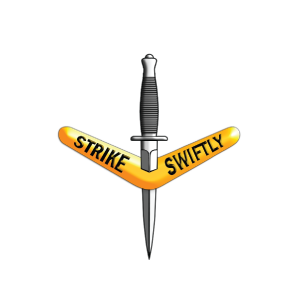
The first “boomerang and dagger badge” was later issued to all ranks in 1956. (See next article on history of the badge)
The unit by then had adopted as its headdress the Green Beret (“Sherwood” green) made famous by the British Army Commandos of World War 2 and the present-day Royal Marine Commando.
The Green Beret was, and is still awarded, only to a member who has successfully qualified at a number of rigorous tests AND volunteered for overseas service. Following selection, the tests that had to be completed in 1956 included the following:
Speed marching 6 miles in 72 minutes
Scramble course - 1½ miles rough country. Completion time according to the ground
Cross-country marching (map reading and endurance)
Battle tests 20 miles in 7 hours
Tests of Elementary Training (TOETS) for Rifle, Light Machine Gun, Grenade and handling tests with Owen Machine Carbine.
Be a qualified shot with Rifle, LMG and OMC.
Qualify at one of the following > Parachuting, Canoeing, Cliff Climbing or Underwater Swimming. AND, the same tests will apply to Regular Army and CMF members!
(Source: National Archives)
The Deputy Chief of the General Staff on 19 December 1956 stated in a memorandum, “It is considered that the general issue of the Green Beret to individuals WITHOUT qualification has serious disadvantages. Some of these are:
Its traditional value will be depreciated, and we may find that the cooperation of the Royal Marines in training our instructors will not be so wholehearted.
The motivation for the individual to acquire certain military skills will be removed.
The “elite” quality of the units will disappear. It is essential to retain this quality in view of the nature of their employment in war.
The tremendous morale value of the green beret will be lost”.
(Source- National Archives)
In 1957, as the unit had already had the designation “1st” within its title, the Army thought it would be a convenient framework on which to re-form the old 1st Battalion. So on December 1, 1957 the unit was redesignated as 1st Infantry Battalion (Commando), until June 1960 when the unit was renamed 1st Battalion Royal New South Wales Regiment (Commando). The City of Sydney’s Own Regiment. In March 1973, the unit the name at last changed back to the former designation of 1 Commando Company and today, that name continues.
In January 1961, the raising of 126 Commando Signals Squadron, based in Melbourne, provided communications support for both Commando Companies On February 1, 1981 the 1st Commando Regiment was formed and 1 Commando Company, 2 Commando Company and 126 Signals Squadron came together under the Australian Special Forces umbrella (With the Special Air Service Regiment based in Perth, Western Australia) A Special Forces Directorate was formed in 1982 and so at last, the SF concept was now accepted as part of the Australian Army.
The Australian Army then raised a Regular Army Commando unit in 1997 within the 4th Royal Australian Regiment; this was the first time since 1945 that Australia had had a “full-time” Commando unit.
The specialist skills of 1 Commando Regiment and members of both the Companies were once again called upon to form the training team that would select and train Regular Army soldiers to make up 4 RAR (Cdo). Reservists training Regular Army Soldiers.
May 2003 saw the formation of The Special Operations Command, which includes The Special Air Service Regiment, 4 RAR (Cdo), 1 Commando Regiment and the Incident Response Regiment (Responsible for the handling of hazardous materials, nuclear, biological, etc).
Whilst the Commando units have not seen combat action, several members of both Companies have served overseas, during the Vietnam War with the Australian Army Training Team and the Special Air Service, and in peacetime using their specialist training as boat operators, signallers and medics in the Solomon Islands, Bougainville, East Timor and recently in the Middle East.
Some members of the unit have been highly decorated for service in the Australian Army, including one Victoria Cross, Distinguished Service Cross, Distinguished Conduct Medals, 2 Military Crosses and numerous foreign decorations. (One ex-member is the only nonAmerican to be inducted into the US Ranger “Hall of Fame”.
There has been a long association with the Australian Special Air Service, who have posted training staff to the units over the years, and during the Vietnam conflict, several of our members provided the manning of 2 and 3 squadrons SAS when they were raised in the ‘60s.
1 Commando Company has not been without its heroes and larrikins over the years, and among these are the heroic exploits of Sergeant Rayene Stewart SIMPSON VC. DCM. Ray was posted to 1 Commando Company in a training role from 1st Special Air Service Company, after his first tour of duty with the Australian Army Training Team Vietnam (AATTV) in 1962. He was promoted to Warrant Officer Class 2 (WO2) prior to his second tour in July 1964, again with the AATTV.
In September that year, despite being badly wounded and with severe loss of blood, he was awarded the Distinguished Conduct Medal for bravery, whilst serving as an advisor with a South Vietnamese Special Forces group. However, rumour has it that he was never “officially” posted to Vietnam on his third tour in 1967. Ray had been discharged from the Army in May 1966, but he re-enlisted a year later in an unusual way - Instead of parading for a scheduled medical, he simply paraded for the next aircraft bound for Saigon. On arrival, he obtained a weapon and then set about finding something “useful to do”, and once again joined the AATTV.
On this tour, WO2 Ray Simpson was awarded the VICTORIA CROSS as commander of a Mobile Strike Force. The citation reads:
“On the 6th of May 1969, Warrant Officer Simpson was serving as Commander of 232nd Mobile Strike Force Company of 5th Special Forces Group on a search and clear operation in Kontum Province, near the Laotion border. When one of his platoons became heavily engaged with the enemy, he led the remainder of his company to its assistance. Disregarding the dangers involved, he placed himself at the front of his troops, thus becoming a focal point of enemy fire, and personally led the assault on the left flank of the enemy position. As the company moved forward an Australian Warrant Officer commanding one of the platoons was seriously wounded and the assault began to falter. Warrant Officer Simpson, at great personal risk and under heavy fire, moved across open ground, reach the wounded Warrant Officer and carried him to a position of safety.
He then returned to his company where, with complete disregard for his safety, he crawled forward to within 10 metres of the enemy and threw grenades into their positions. As darkness fell, and being unable to break into the enemy position, Warrant Officer Simpson ordered his company to withdraw. He then threw smoke grenades and, carrying a wounded platoon leader, covered the withdrawal of the company together with five indigenous soldiers.
His leadership and personal bravery in this action were outstanding. On 11 May 1969, in the same operation, Warrant Officer Simpson's Battalion Commander was killed and an Australian Warrant Officer and several indigenous soldiers were wounded. In addition, one other Australian Warrant Officer who had been separated from the majority of his troops was contained in the area by enemy fire. Warrant Officer Simpson quickly organised two platoons of indigenous soldiers and several advisers and led them to the position of the contact. On reaching the position, the element with Warrant Officer Simpson came under heavy fire, and all but a few of the soldiers with him fell back. Disregarding his own safety, he moved forward in the face of accurate enemy machine gun fire in order to cover the initial evacuation of the casualties. The wounded were eventually moved out of the line of enemy fire, which, all this time was directed at Warrant Officer Simpson from close range.
At the risk of almost certain death, he made several attempts to move further towards his Battalion Commander's body, but on each occasion, he was stopped by heavy fire. Realising the position was becoming untenable and that priority should be given to extricating other casualties as quickly as possible, Warrant Officer Simpson, alone and still under enemy fire, covered the withdrawal of the wounded by personally placing himself between the wounded and the enemy. From this position, he fought on and, by outstanding courage and valour, was able to prevent the enemy advance until the wounded were removed from the immediate vicinity. Warrant Officer Simpson's gallant and individual action and his coolness under fire were exceptional and were instrumental in achieving the successful evacuation of the wounded to the helicopter evacuation pad.
Warrant Officer Simpson's repeated acts of personal bravery in this operation were an inspiration to all Vietnamese, United States and Australian soldiers who served with him. His conspicuous gallantry was in the highest tradition of the Australian Army”.
The 1st Commando Regiment of the 21st century still maintains the same ethos as when the Companies were first formed, of selecting intelligent, highly motivated, fit soldiers to serve in the most elite unit in the Australian Army Reserve. The selection process, although changed little since 1955, still focuses on fitness, endurance, weapon skills and self-discipline.
THE ORIGIN OF THE AUSTRALIAN COMMANDO BADGE (STRIKE SWIFTLY)
We repeat the history of the origin of our badge, which has been often misquoted, and sometimes incorrect versions exist. We quote directly from a letter sent to us by Brig. W.H. (Mac) Grant OAM, RFD, Ret’d, and we are indebted to his generosity. “On the 12th of November 1954, Army Headquarters issued the necessary authority for the raising of two new units in the Austra Army. The units were to be designated 1st Commando Company, to be raised and based in Sydney and 2nd Commando Company to be raised and based in Melbourne. The parent corps for both units was the Royal Australian Infantry.
At the time, I was on the strength of the Royal Australian Regiment, having recently returned to Australia after service in Korea and Japan. I was appointed to raise and command 1st Commando Company. Major Peter Seddon RAA was appointed to raise and command 2nd Commando Company. Peter and I were old friends, which was a great advantage for us both.
Army Headquarters were then located in Melbourne. At the first opportunity, I was called to Melbourne for a joint briefing with Peter by the General Staff. Nobody really knew very much about what was required of us, and to a large degree, we were given ‘carte blanche’ as to how we went about raising the new units.
Australian Army Staff, London, tried to be as helpful as possible and sent us copies of the establishment and equipment tables for the Royal Marine Commandos. However, there great deal we did not know, and both Peter and I became avid readers of anything to do with Commandos, including an official British publication entitled “The Green Beret”. We were fortunate that a British training film of the same name was available for special screenings in both Sydney and Melbourne to all volunteers for the new units.
In October 1955, I went to the UK with Major Jack Anderson, O C Designate 2nd Commando Company, Warrant Officer Smith and Warrant Officer Tarr, both of whom were to become training instructors with the Royal Marines. Sadly, Major Anderson was killed during the last week of the basic commando course at Bickleigh in Devon. He was replaced by Major John Hutcheson.
I returned to Sydney in May 1956 and went to Melbourne for a liaison visit with Peter Seddon as soon as possible. The knowledge I had acquired during my seven months with the Royal Marines now provided invaluable and Peter and I had very useful discussions.
However, one area where it was obvious we must make our own way was the design of a suitable commando badge. The frontispiece photo in “The Green Beret” showed a beret with a bursting grenade badge. Perhaps because he was a gunner, Peter was very keen on adopting this as the badge for Australian commandos. I pointed out that throughout World War 2, the commandos of the British Army had continued to wear the badge of their previous parent unit. We finally agreed that a completely new design was called for and decided to run a competition for all ranks in both units.
As some excellent drawings were submitted, and in the end, Peter sent all the proposed designs to me in Sydney and requested that I should make a selection. Although very impressive, many of the designs were completely impractical from a manufacturing viewpoint. Daggers of various designs were common to many designs, and finally, I came up with the idea of combining two proposals, one from Melbourne and one from Sydney. The result was the present commando badge.
At the time, I was reading a British commando book, from memory, the history of No. 4 Commando of the British Army, entitled “Swiftly They Struck”. The thought occurred to me that by transposing some of the words, “Strike Swiftly” would make a very suitable motto for inclusion on the badge. Peter Seddon agreed and so the present regimental badge came into being.”
Signed Brigadier W.H. Grant
Patron
1 Commando Association Inc.
We acknowledge considerable input into the design from Wo2 Ron Smith who served with 2 Commando Company and who later went on to serve with the AATTV.
1 COMMANDO ASSOCIATION INC.
1 Commando Association was registered in May 1976 by former soldiers who served with 1 Commando Company to perpetuate the “Esprit de Corps” that develops particularly among Special Forces units, and was open only to former serving members of the unit.
Today, membership is open to the following: Any natural person who has been on the posted strength of any of the following units of the Australian Army.
1 Company, 1st Commando Regiment, or any of its predecessors in title, namely 1 Commando Company, the 1st Battalion of the Royal New South Wales Regimen (Commando), the 1st Infantry Battalion (Commando) and 1 Commando Company, 1 st Commando Regiment or 1 Commando Company t
2 Company, 1st Commando Regiment, or either of its predecessors in title, namely, 2 Commando Company and 2 Commando Company, 1st Commando Regiment,
126 SignalsSquadron, 1st Commando Regiment, or its predecessors in title, namely, 126 Squadron Headquarters, 1st Commando Regiment or 12 6 Signals Squadron;
The Independent Companies and/or Commando Squadrons raised during 1939-45
'M' & 'Z' Special Units
And any other regiment, battalion, unit or subunit designated as Commando or Special Forces.
The person is or has been on the posted strength of any unit or subunit of the Royal Marine Commando of the Royal Navy.
All membership applications are processed and approved by the elected Committee of 1 Commando Association Inc.


